Hardware / Embedded Engineering Services
Embedded Engineering Services
Embedded systems engineering for products that have to work in the real world — not a proof of concept that only runs on a bench. This is the whole-system engagement: the board and the software on it, taken together. Need only one half? See PCB Design or Firmware & Embedded Software.
What we build
- Embedded systems architecture
- Microcontroller and SoC selection
- Real-time signal processing
- Power, interfaces, and peripheral design
- Mixed-signal and sensor front ends
- Bring-up, debugging, and validation
- Hardware prototyping and assembly
- Pre-compliance for CE / FCC / EMC
What a system actually consists of
The signal path is the part everyone draws. The row underneath is the part that usually breaks.
The signal path
SENSOR
what is being measured, and what it needs in order to be measured properly
FRONT END
analog conditioning, or the digital interface the part actually speaks
ACQUISITION
sampling and buffering, without losing data under load
CONTROLLER
the part that has to do the work in the time available
LINK OUT
what leaves the device, and how often
And everything that decides whether it works
POWER
rails, sequencing, noise, and what the budget really is
CLOCK
one time base, distributed to everything that needs it
MECHANICS
where parts sit, what they see, and what they are bolted to
TEST ACCESS
the points you will want to probe at three in the morning
Proven on our own platform
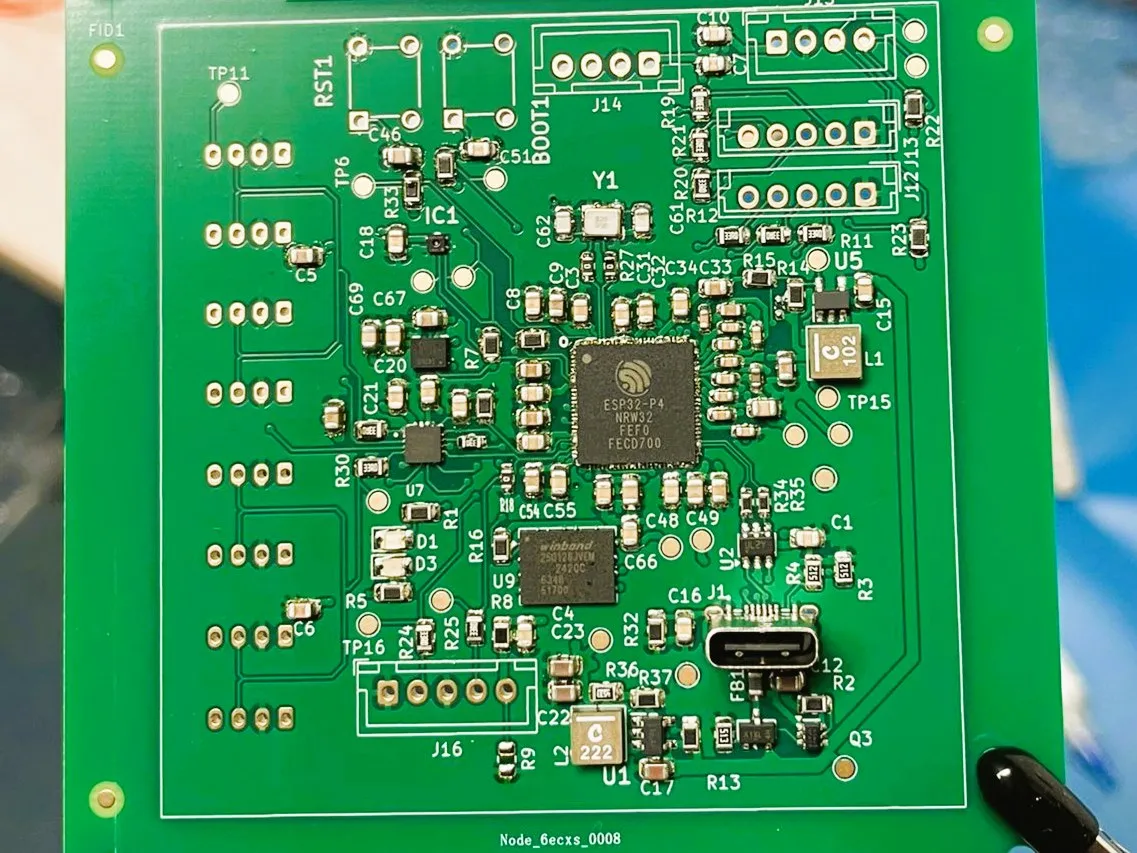
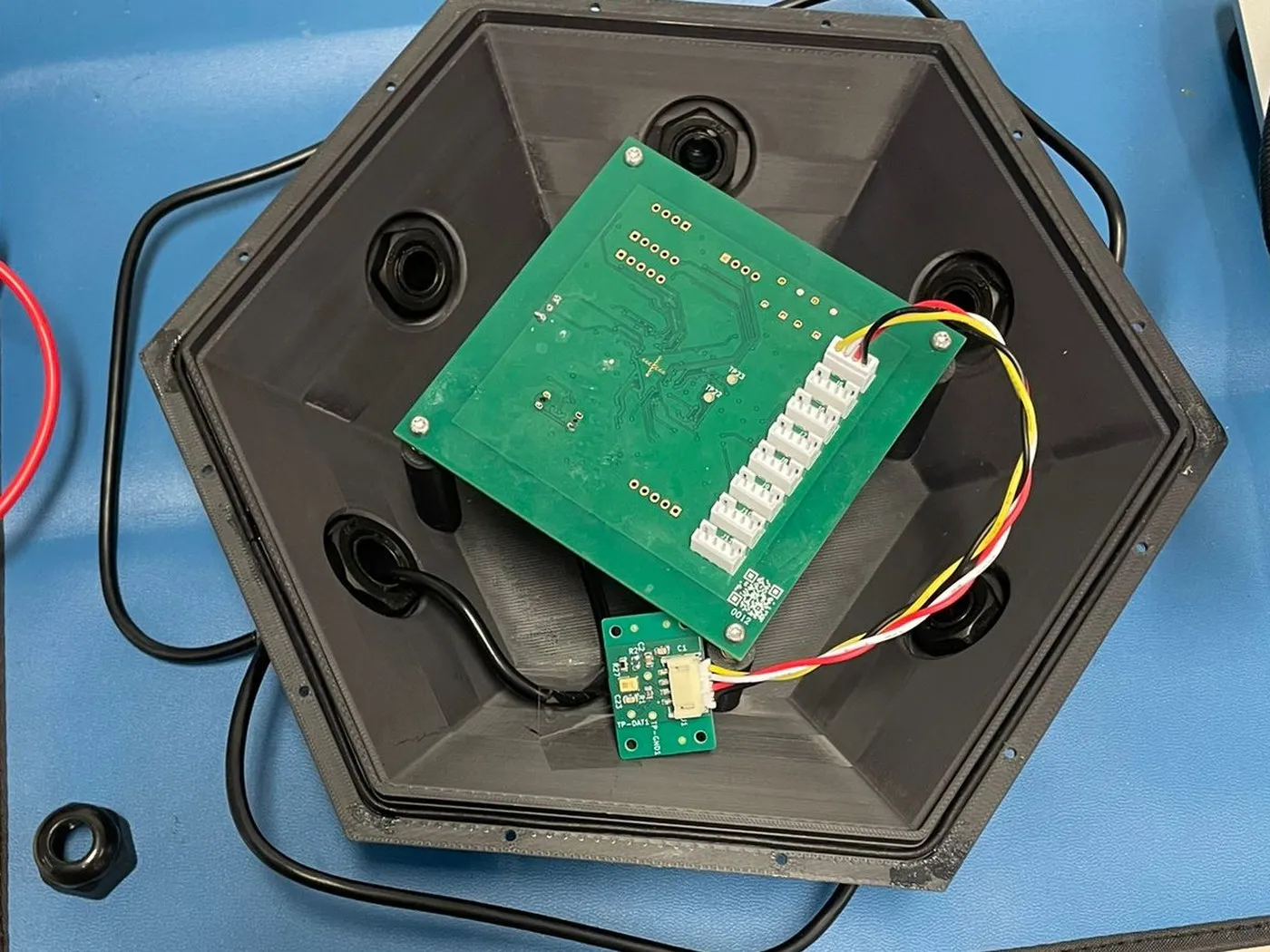
Our own sensor platform was designed, built and brought up here, from a blank schematic to a device measured against surveyed ground truth: custom boards, an ESP32-P4 controller, eight synchronized channels, and real-time firmware doing the work on the node. Three board designs, each through at least one revision driven by what the bench showed.
Whole-system engagements exist because the hard questions sit between the disciplines. Whether a channel is clean is partly layout and partly firmware. Whether the battery lasts is partly the part choice and partly the duty cycle. Whether the sensor reads correctly is partly the front end and partly where the enclosure puts it. With one team on both sides those get answered once, instead of argued about twice and then discovered late.
See the system and its measurements →Hardware prototyping
A prototype is not a milestone. It is the thing that tells you what the design got wrong.
Prototype design and iteration
A first build that exists in order to be measured, and then the revision the measurements asked for. Boards that have never been revised have usually never been tested properly.
Sourcing and assembly
BOM sourced and boards populated here in prototype quantities, which keeps the loop between a design decision and a physical board short. We are not a contract manufacturer: for series production we prepare the documentation and work with yours.
Bring-up and hardware debugging
Power up, prove each subsystem, then measure it. Where the board is wrong it gets found on the bench rather than in the field, and the correction lands in the next revision.
Pre-compliance for CE, FCC and EMC
Physical products carry requirements pure-software projects never have to think about. We design with them in mind and prepare for testing; the formal testing is carried out by accredited third parties, because we are not a certification lab.
The enclosure and the mechanical parts are developed against the boards in the same place — rather than drawn around a finished design afterwards. See 3D CAD Design →
What the work usually involves
Architecture
What runs where, on which part, against what constraints. Settled before layout, because it determines the layout.
Part selection
Controller, sensor and supply chosen for availability and lifecycle as much as for the datasheet. A perfect part you cannot buy is not a part.
Power and thermals
Rails, sequencing, quiescent draw and where the heat goes, sized against the duty cycle the device will really see.
Interfaces
The buses between parts, and what leaves the device — wired, wireless, or deliberately neither.
Bring-up and validation
Each subsystem proven and then measured. Findings written down, including the ones that mean another revision.
Handover
Schematics, layout, firmware, and the notes explaining why it is the way it is. You own the design when we are done.
Related
Have a device to architect?
Bring the requirement and the constraints — what it has to measure or do, on what power, in what environment. You get an honest read on the approach and on what the hard part will turn out to be.
Discuss a project →